
Newsletter Subscribe
Enter your email address below and subscribe to our newsletter

 ByJohn A
Have you ever had a cool game concept but didn’t know how to develop it? Creating games may seem intimidating when you consider the coding, the design, the characters and the levels. However, novices are now able to use basic internet tools without the need to spend years acquiring formidable technical skills.
Platforms such as Astrocade allow complete novices a simple way to start playing with game creation and various concepts. You can begin with a simple idea, get to know the core tools, and gradually work your way up. This tutorial will help you to begin and to simplify your path.
Creating games can be a lot less intimidating for newcomers if they’re equipped with the right resources. Online game creators usually provide visual editors, templates, game assets, and simple controls. These features enable you to treat different parts of a game without needing to work with complicated software.
Also, experiment with various instruments before you get the best tool for you. Some are geared toward building simple games, while others provide more advanced capabilities. Choose an application that you can easily understand and that has the right features for your first game.
Your first project need not be large or complicated. Think of a clear one-liner and work out what the player does. A basic platform game, a racing game, a puzzle game, or a short adventure game also works.
When you have an idea, begin by coding a basic version of the game mechanics. Stick a character in there, create a tiny level, give your player something simple to do. When you’ve started adding more levels challenges sound and pretty things as your project grows you can do that.
Designing a game is designing for player comprehension and fun. You need to consider controls, objectives, obstacles, rewards, characters, and levels. Even a relatively simple game can be fun if all of these things are well balanced.
Begin with the player’s experience in mind. Make the first level something easy to get through, and then have the latter levels add some plot twists. You can also play around with game mechanics and see what brings something more to the table for your project.
Good design isn’t about cramming in every feature you can think of. A good idea is better than a million bad ones that are half baked. Make the core gameplay fun, then add the extras.
Mini Projects are a great way to learn Game Development. Instead of taking on a massive open-world game, make something you can complete quickly. A mini project allows you to get a feel for levels, characters, controls and testing.
A game in which you collect things while you dodge things, can also be made. When the basic version is working, you can add new levels or make the game more difficult. Everything you improve on, every step nicer you make teaches you something that will help you the next time you make a project.
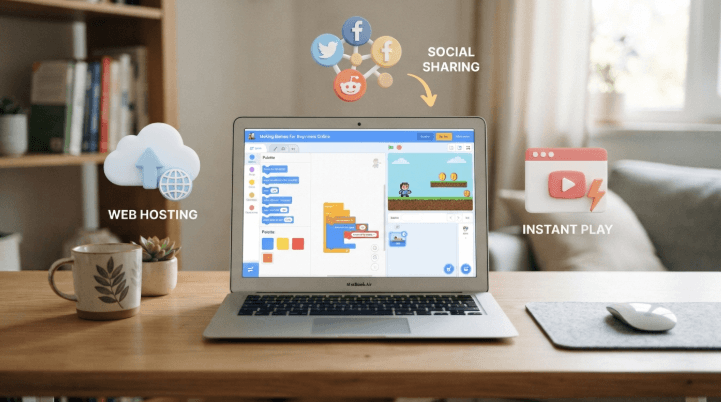
When your game is finished, sharing it can be a fun part of the process. You can allow friends or other users playtest your project and gauge their reactions. They can help you identify issues that you may not have seen.
Test the controls, levels, sounds and so on before you release your game. Ensure the players know what is required of them. A quick playtest session is enough to squash some bugs and make a significant difference.
Sharing games can also inspire you to continue learning. You may get new ideas for future updates when people play your project. Then you can work up to larger projects and find your own style.
You can make learning game development online easy and fun when you have this mindset at the beginning. You don’t have to create a massive project right off the bat. Start Small – Learn the tools basics by making a simple game, test your game play and ideas, get feed back and evolve your ideas.
As you learn, you can play around with new characters, levels, mechanics, and game worlds. You can take a crack at concepts from a game like Blade Evolve or make your own spin on them. Keep at it, listen to your players, and have fun making your ideas playable.
See also: Maximizing Sales Opportunities: The Benefits of Using Opportunity Management Software
Yes, there are many web tools that beginners can use for game development. They might include visual editors, templates, assets, and other features that make the process easier.
Not necessarily. Some game-making platforms use visual, drag-and-drop tools, allowing beginners to create basic games without writing code.
A basic platformer, arcade challenge, small puzzle, or short adventure makes a manageable first project. Pick one with an easy-to-understand objective and only a few features to build.
Practice by making small projects and seeing how things are done in other games. Controls, level design, challenges, rewards, and player feedback, take note of them all.
Yes, if you don’t mind doing so. You can get feedback on your project by sharing it, which can help you learn what players like or struggle with. Only you should test the game first before you release it.
